 |
Professor Shujun LI (李树钧) FBCS SrMIEEE MACM Director, Institute of Cyber Security for Society (iCSS) (an ACE-CSR and an ACE-CSE) Professor of Cyber Security and Head of Cyber Security Research Group, School of Computing Kennedy Building, University of Kent (part of London and South East University Group) Canterbury, Kent, CT2 7FS, UK |  |
| Email: hooklee@gmail.com (private), S.J.Li@kent.ac.uk (work) | ||
Quick Links and News


 LSFWG (Learned Society Formation Working Group)




- Resource (actively updated): With the help of LLMs, Shujun converted his old static call for papers page into a dynamic page with many useful features.
- Resource (last updated on 20 March 2026): Shujun is maintaining an online bibliography of SoK (Systematization of Knowledge) papers.
- Selected News about Shujun's Research Work and Professional Activities: one paper on human detection of deepfake face images accepted to IEEE S&P 2027; joined EAI SecureComm 2027 Organizing Committee as PC Co-Chair; joined USENIX Security 2027 Program Committee; one paper on orchestrating open-weight SLMs and LLMs for malware analysis accepted to RAID 2026; one paper on scam-driven human trafficking across Chinese borders using data from RedNotes won a Best Paper Award and another one on people with intellectual disabilities and social VR got a Honorable Mention at CHI 2026; co-chaired AI-SS 2026 workshop co-located at EDCC 2026; one paper on GDPR-oriented analysis of privacy policies published by IEEE Transactions on Dependable and Secure Computing in 2026
- Selected Public Engagement Activities: Shujun has coordinated many school outreach activities, e.g., multiple NCSC CyberFirst events for local schools in Kent and Medway. In 2023 he co-founded three local community building bodies for the Kent and Medway region and since then has been (co-)leading their activities: KMCSN (Kent & Medway CyberSchools Network), KMCS3 (Kent & Medway Cyber Security Student Society), and KMCC (Kent & Medway Cyber Cluster). He led the 2023-24 iCSS-KMCC-KMCS3 CyberAnything Competition and the 2024 iCSS Cyber Security Awareness Month (which included the 2024 "Creative Cyber" Exhibition as a major highlight). Between 2022 and 2026, he coordinated the production of three animated videos for cyber security awareness and co-produced one two-episode documentary.
- May 2026: A documentary "Generation Cyber" (Episode 1 and Episode 2) for educating 11-15-year-olds about cyber security and AI. It was co-produced by iCSS and KMTV, as the main outcome of a DSIT/Innovate UK-funded Cyber Local 2025-2026 project and part of the 'Generation' Series (YouTube channel). Shujun served as one of the three Executive Producers and appeared in Episode 2 as the deliverer of a deepfake educational session at Five Acre Wood School in Maidstone.
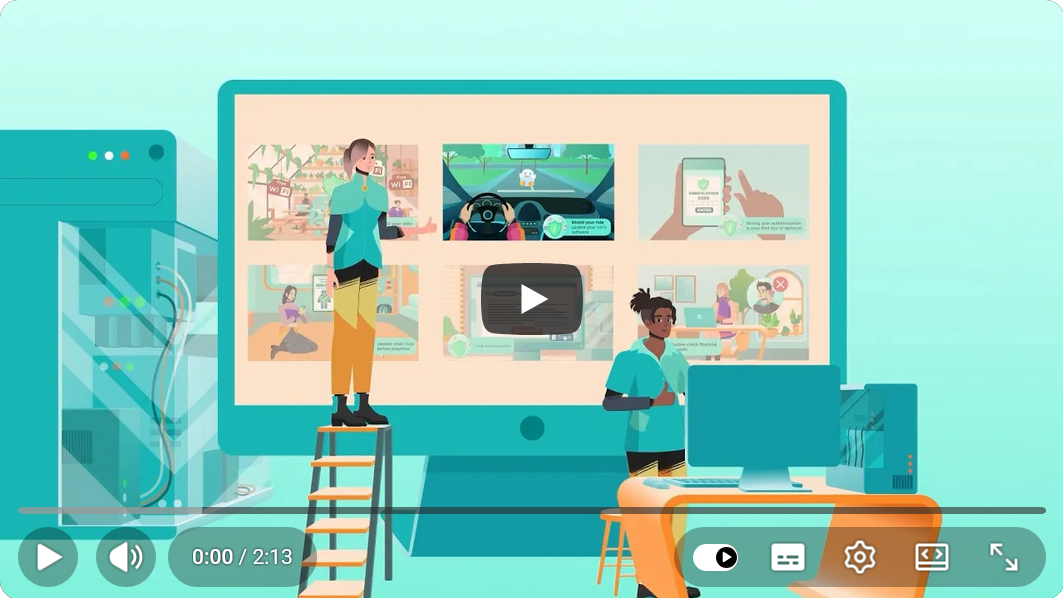
- February 2026: "How cyber professionals help keep us safe online" (@SciAni YouTube channel) for promoting work of cyber professionals (a news story; jointly released with KMCC; SciAni as the producer; supported by NCSC CyberFirst, UKC3 and KMTV)
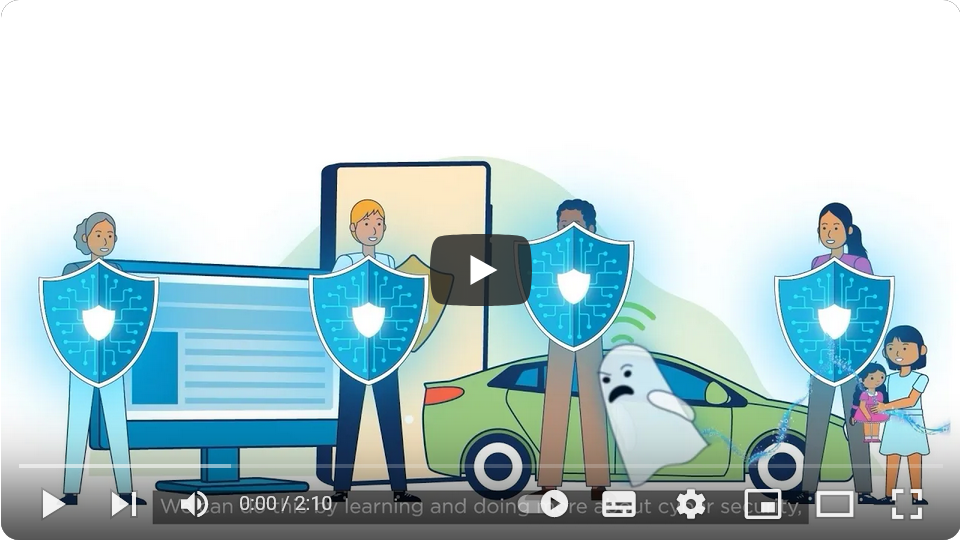
- November 2023: "Why does cyber security matter for everyone?" (@SciAni YouTube channel) for the general public (a news story; SciAni as the producer)
- November 2022: "How to be a cyber superhero" (@Scriberia YouTube channel) for young children to understand more about the interdisciplinary nature of cyber security, the diverse career options and the importance of continuous learning and collaboration (an e-book, a news story; Scriberia as the producer)



Brief Biography (CV)
Shujun Li received his BE degree in Information Science and Engineering in 1997, and his PhD degree in Information and Communication Engineering in 2003 under supervision of Prof. Yuanlong Cai (蔡元龙) and Prof. Xuanqin Mou (牟轩沁), both from the Xi'an Jiaotong University (西安交通大学). During 2003 to 2005, he was a postdoctoral Research Assistant with the Department of Electronic Engineering, City University of Hong Kong (香港城市大学), under supervision of Prof. Guanrong (Ron) Chen (陈关荣). From 2005 to 2007, he was a postdoctoral fellow funded by The Hong Kong Polytechnic University (香港理工大学)'s Postdoctoral Fellowships Scheme, working at the Department of Electronic and Information Engineering with Dr. Kwok-Tung Lo (卢国栋). From 2007 to 2008, he was a Humboldt Research Fellow and doing his research at the FernUniversität in Hagen, Germany, hosted by Prof. Dr. Dr. Wolfgang A. Halang. From 2008 to 2011, he was a 5-Year Research Fellow at the Zukunftskolleg (Institute for Advanced Study), Universität Konstanz, Germany, and a junior faculty member of the Department of Computer and Information Science, working closely with Prof. Dr. Dietmar Saupe's group on Multimedia Signal Processing. In September 2011, he joined the Department of Computing (renamed to Department of Computer Science in August 2015), University of Surrey, UK, as a Senior Lecturer and then a Reader (Associate Professor). From 2014 to 2017, he was a Deputy Director of the Surrey Centre for Cyber Security (SCCS), leading the cross-cutting research theme Human Factors (known as Human-Centred Security between July 2014 and January 2017). Since November 2017, he has been a Professor of Cyber Security at the University of Kent, leading the Security Group of its School of Computing and the university-wide Kent Interdisciplinary Research Centre in Cyber Security (KirCCS). From January 2021, he has been the Founding Director of the Institute of Cyber Security for Society (iCSS), the third university-wide institute at the University of Kent. Since 2000, Shujun Li has published over 100 scientific papers with six Best Paper Awards and two Honorable Mention Awards, and his research interests are mainly on cyber security (including usable security and user privacy, digital forensics and cyber crime, cyber law and cyber/data/AI governance, security and privacy in online social networks, mobile security and systems security in general, human behavior/legal aspects/scam/crime/privacy aspects and AI/multimedia related to distributed ledger techonologies and cryptocurrencies, information hiding), data analytics and multimedia computing (including visual quality assessment and image/video coding), and human factors (including usability, human behaviors, and accessibility), applications (i.e., NOT theory) of artificial intelligence including LLMs and NLP, cyber and AI education and learning. He also keeps his older research interests in applications of discrete optimization to multimedia computing especially recovering of unknown/missing/lost/manipulated information in digital images and videos (see here for a representative publication), and interdisciplinary topics betwen nonlinear science (chaos/fractals) and electronic engineering and computer science epecially digital degradation of chaotic systems in the digital domain (see here and here for two representative publications) and cryptanalysis of chaos-based secure communications schemes and digital ciphers. More about Shujun's research interests can be found here. Shujun Li is a Fellow of the BCS, a Senior Member of the IEEE, a Professional Member of the ACM and a Global Member of the Internet Society (ISOC). From 2009-2011 he was a member of MPEG (ISO/IEC JCT 1/SC 29/WG 11), and in 2012 was awarded an ISO/IEC Certificate of Appreciation for being the lead editor of ISO/IEC 23001-4:2011 "Information technology – MPEG systems technologies – Part 4: Codec configuration representation", the 2nd edition of the MPEG RVC standard.
Professional Activities
To Prospective Research (PhD/Visiting) Students
To Prospective RAs/RFs/VRs
Terms: RAs = (Postdoctoral) Research Assistants / Research Associates, RFs = (Postdoctoral) Research Fellows, VRs = Visiting ResearchersIf you have obtained your doctoral degree and want to do research with Shujun as an RA/RF or a VR, please check the News section of this page and my Research page for research positions. When there are no open positions, you are still welcome to contact Shujun as there are various research fellowship schemes he can help you apply.
Scientometrics
Such quantitative scientometrics are provided here for reference only and should be used with great caution. Remember this: "Not everything that can be counted counts, and not everything that counts can be counted." Read Shujun's presentation on "How to Do (Good) Research? Starting from Scientometrics..." to understand more about his views of such scientometrics.h-index
Self-Citations Excluded:h-index = 47 (according to data on ResearchGate)
Self-Citations Included:
h-index = 50 (according to data on ResearchGate)
h-index = 55 (according to data on Google Scholar Citations)
Erdős Number = 3
This scientometric is more for fun. There are other similar metrics defined by people, e.g., Bacon's number and Morphy number.- Paul Erdős
 Prof. Charles K. Chui (崔锦泰) Prof. Guanrong Chen (陈关荣) Shujun Li
 - Paul Erdős Prof. Ron C. Mullin Prof. Spyros S. Magliveras Shujun Li
Research Grants/Fellowships
Selected Publications
- Zhiqing Guo*, Lixin Jia*, Luning Sun*, Xiaowei Chen, Guofeng Yu, Liejun Wang, Gaobo Yang, David Stillwell, Thorsten Holz and Shujun Li, "From GAN-Based Models to GPT-5: A Taxonomy-Guided Study of Human Performance in Detecting Deepfake Face Images," accepted to IEEE S&P 2027 (48th IEEE Symposium on Security and Privacy) in September 2026, in press (Acceptance rate: 160/1012 valid submissions=15.8%) © IEEE
- Adel ElZemity, Shujun Li and Budi Arief, "Small, Free, and Effective: Orchestrating Open-Weight Small Language Models to Outperform Single LLM for Malware Analysis," accepted to RAID 2026 (29th International Symposium on Research in Attacks, Intrusions and Defenses) in July 2026, to be published in a volume of Lecture Notes in Computer Science (LNCS) (Acceptance rate: 58/306 valid submissions=19.0%)
 © Springer Nature
 - Peng Tang, Xin Li, Yuxin Chen, Weidong Qiu, Haochen Mei, Allison Holmes, Fenghua Li and Shujun Li, "A Comprehensive Study on GDPR-Oriented Analysis of Privacy Policies: Taxonomy, Corpus and GDPR Concept Classifiers," IEEE Transactions on Dependable and Secure Computing, Volume 23, Issue 4, pp. 7768-7782, 2026


 © IEEE
 - Jiamin Zheng, Yue Deng, Jessica Chen, Shujun Li, Yixin Zou and Jingjie Li, "Characterizing Scam-Driven Human Trafficking Across Chinese Borders and Online Community Responses on RedNote," in Proceedings of the 2026 CHI Conference on Human Factors in Computing Systems (CHI 2026), Article Number 1313, 25 pages, ACM, 2026 (
 Best Paper Award = top 1% of all submissions) © Authors
 - Alexandra Covaci, Winnie Tsang, Sophia Ppali, Paraskevi Triantafyllopoulou, Monica Perusquia-Hernandez, Oscar Zhou, Fotis Liarokapis, Marios Constantinides, Mohamed Khamis and Shujun Li, "When the World Opens Up: Journeys of People with Intellectual Disabilities in Social Virtual Reality," in Proceedings of the 2026 CHI Conference on Human Factors in Computing Systems (CHI 2026), Article Number 991, 21 pages, ACM, 2026 (
 Honourable Mention Award = top 5% of all submissions) © Authors
 - Adel ElZemity, Budi Arief and Shujun Li, "Analysing Safety Risks in LLMs Fine-Tuned with Pseudo-Malicious Cyber Security Data," in Computer Security. ESORICS 2025 International Workshops: ANUBIS 2025, SECAI 2025, SecAssure 2025, STMUS 2025, Toulouse, France, September 22–24, 2025, Revised Selected Papers, Part II, pp. 346–365, Springer, 2026 [Accepted to SECAI 2025 (3rd International Workshop on Workshop on Security and Artificial Intelligence), a workshop co-located with ESORICS 2025 (30th European Symposium on Research in Computer Security), in August 2025] © Authors
- Adel ElZemity, Budi Arief and Shujun Li, "CyberLLMInstruct: A Pseudo-Malicious Dataset Revealing Safety-Performance Trade-offs in Cyber Security LLM Fine-tuning," in Proceedings of the 18th ACM Workshop on Artificial Intelligence and Security (AISec 2025, a workshop co-located with ACM CCS 2025), pp. 77-88, ACM, 2025

 © Authors
 - Zsofia Baruwa, Haiyue Yuan, Shujun Li and Zhen Zhu, "Constructing and Analysing Global Corporate Networks with Wikidata: The Case of Electric Vehicle Industry," Global Networks, Volume 25, Issue 4, Article Number e70029, 17 pages, John Wiley & Sons, Inc., 2025

 © Authors
 - Enes Altuncu, Can Başkent, Sanjay Bhattacherjee, Shujun Li and Dwaipayan Roy, "FACTors: A New Dataset for Studying the Fact-checking Ecosystem," in Proceedings of the 48th International ACM SIGIR Conference on Research and Development in Information Retrieval (SIGIR 2025), pp. 3530-3539, ACM, 2025 © Authors
- Yuqi Niu, Weidong Qiu, Peng Tang, Lifan Wang, Shuo Chen, Shujun Li, Nadin Kökciyan and Ben Niu, "Everyone's Privacy Matters! An Analysis of Privacy Leakage from Real-World Facial Images on Twitter and Associated User Behaviors," Proceedings of the ACM on Human-Computer Interaction (PACMHCI), Volume 9, Issue 2, Article Number CSCW069, 38 pages, ACM, 2025, accepted via CSCW 2025 (28th ACM Conference on Computer-Supported Cooperative Work and Social Computing), in Bergen, Norway on October 18-22, 2025 © Authors
- Yangde Wang, Weidong Qiu, Weicheng Zhang, Hao Tian and Shujun Li, "SE#PCFG: Semantically Enhanced PCFG for Password Analysis and Cracking," IEEE Transactions on Dependable and Secure Computing, Volume 22, Issue 4, pp. 4428-4441, 2025 © IEEE
- Xuewen Dong, Jiachen Li, Shujun Li, Zhichao You, Qiang Qu, Yaroslav Kholodov and Yulong Shen, "Adaptive Backdoor Attacks with Reasonable Constraints on Graph Neural Networks," IEEE Transactions on Dependable and Secure Computing, Volume 22, Issue 4, pp. 4053-4069, 2025 © IEEE
- Peng Tang, Xiaoyu Zhu, Weidong Qiu, Zheng Huang, Zhenyu Mu and Shujun Li, "FLAD: Byzantine-robust Federated Learning Based on Gradient Feature Anomaly Detection," IEEE Transactions on Dependable and Secure Computing, Volume 22, Issue 4, pp. 3993-4009, 2025 © IEEE
- Zhichao You, Xuewen Dong, Shujun Li, Ximeng Liu, Siqi Ma and Yulong Shen, "Local Differential Privacy is Not Enough: A Sample Reconstruction Attack against Federated Learning with Local Differential Privacy," IEEE Transactions on Information Forensics and Security, Volume 20, pp. 1519-1534, 2025 © IEEE
- Rahime Belen-Saglam, Haiyue Yuan, Maria Sophia Heering, Ramsha Ashraf and Shujun Li, "A Systematic Literature Review on Cyber Security and Privacy Risks in MaaS (Mobility-as-a-Service) Systems," Information, Volume 16, Issue 7, Article Number 514, 36 pages, MDPI, 2025 © Authors
- Nandita Pattnaik, Shujun Li and Jason R. C. Nurse, "Security and Privacy Perspectives of People Living in Shared Home Environments," Proceedings of the ACM on Human-Computer Interaction (PACMHCI), Volume 8, Issue CSCW2, Article Number 368, 39 pages, ACM, 2024, presented at CSCW 2024 (27th ACM Conference on Computer-Supported Cooperative Work and Social Computing) © Authors
- Kai-Fung Chu, Haiyue Yuan, Jinsheng Yuan, Weisi Guo, Nazmiye Balta-Ozkan and Shujun Li, "A Survey of AI-Related Cyber Security Risks and Countermeasures in Mobility-as-a-Service," IEEE Intelligent Transportation Systems Magazine, Volume 16, Issue 6, pp. 37-55, 2024 © IEEE
- Enes Altuncu, Virginia N. L. Franqueira and Shujun Li, "Deepfake: Definitions, Performance Metrics and Standards, Datasets, and a Meta-Review," Frontiers in Big Data, Section of Cybersecurity and Privacy as part of the Research Topic "Cybersecurity and Artificial Intelligence: Advances, Challenges, Opportunities, Threats", Volume 7, Article Number 1400024, 23 pages, Frontiers Media S.A., 2024 © Authors
- Haiyue Yuan, Ali Raza, Nikolay Matyunin, Jibesh Patra and Shujun Li, "A Graph-Based Model for Vehicle-Centric Data Sharing Ecosystem," Proceedings of the 2024 IEEE 27th International Conference on Intelligent Transportation Systems (ITSC 2024), pp. 3587-3594, 2025 © IEEE
- Ruiyuan Lin, Sheng Liu, Jun Jiang, Shujun Li, Chengqing Li and C.-C. Jay Kuo, "Recovering sign bits of DCT coefficients in digital images as an optimization problem," Journal of Visual Communication and Image Representation, Volume 98, Article Number 104045, 14 pages, 2024, Elsevier Inc. © Authors
- Zhanbo Liang, Jie Guo, Weidong Qiu, Zheng Huang and Shujun Li, "When Graph Convolution Meets Double Attention: Online Privacy Disclosure Detection with Multi-Label Text Classification," Data Mining and Knowledge Discovery, Volume 38, pp. 1171-1192, Springer, 2024, accepted via and presented at ECML-PKDD 2024 (36th European Conference on Machine Learning & 28th European Conference on Principles and Practice of Knowledge Discovery in Databases) in September 2024 (Acceptance rate of Research Track papers: 202/826=24.5%) © Authors
- Xin Yuan, Jie Guo, Weidong Qiu, Zheng Huang and Shujun Li, "Support or Refute: Analyzing the Stance of Evidence to Detect Out-of-Context Mis- and Disinformation," in Proceedings of the 2023 Conference on Empirical Methods in Natural Language Processing (EMNLP 2023), pp. 4268-4280, 2023 (Acceptance rate of regular papers: 1047/4909=21.3%) © ACL
- Rahime Belen Sağlam, Enes Altuncu, Yang Lu and Shujun Li, "A Systematic Literature Review of the Tension between the GDPR and Public Blockchain Systems," Blockchain: Research and Applications, Volume 4, Issue 2, Article Number 100129, 23 pages, Elsevier Science B. V. on behalf of Zhejiang University Press, 2023 © Authors
- Sam Parker, Haiyue Yuan and Shujun Li, "PassViz: A Visualisation System for Analysing Leaked Passwords," in Proceedings of the 2023 20th IEEE Symposium on Visualization for Cyber Security (VizSec 2023), pp. 33-42, 2023 © IEEE
- Jamie Knott, Haiyue Yuan, Matthew Boakes and Shujun Li, "Cyber Security and Online Safety Education for Schools in the UK: Looking through the Lens of Twitter Data," in Proceedings of the 38th ACM/SIGAPP Symposium on Applied Computing (SAC 2023), pp. 1603-1606, 2023 © ACM
- Enes Altuncu, Jason R.C. Nurse, Meryem Bagriacik, Sophie Kaleba, Haiyue Yuan, Lisa Bonheme and Shujun Li, "aedFaCT: Scientific Fact-Checking Made Easier via Semi-Automatic Discovery of Relevant Expert Opinions," in Workshop Proceedings of the 17th International AAAI Conference on Web and Social Media, Article Number 27, 10 pages, presented at MEDIATE 2023 (5th Workshop on News Media and Computational Journalism), co-located with ICWSM 2023 (17th International AAAI Conference on Web and Social Media), 2023 © AAAI
- Haiyue Yuan, Matthew Boakes, Xiao Ma, Dongmei Cao and Shujun Li, "Visualising Personal Data Flows: Insights from a Case Study of Booking.com," in Intelligent Information Systems: CAiSE Forum 2023, Zaragoza, Spain, June 12–16, 2023, Proceedings, Lecture Notes in Business Information Processing (LNBIP), Volume 477, pp. 52-60, 2023 © Springer
- Ali Raza, Kim Phuc Tran, Ludovic Koehl and Shujun Li, "AnoFed: Adaptive anomaly detection for digital health using transformer-based federated learning and support vector data description," Engineering Applications of Artificial Intelligence, Volume 121, Article Number 106051, 16 pages, 2023 © Elsevier Science B. V.
- Nandita Pattnaik, Shujun Li and Jason R.C. Nurse, "A Survey of User Perspectives on Security and Privacy in a Home Networking Environment," ACM Computing Surveys, Volume 55, Issue 9, Article Number 180, 38 pages, ACM, 2023 © Authors
- Nandita Pattnaik, Shujun Li and Jason R.C. Nurse, "Perspectives of non-expert users on cyber security and privacy: An analysis of online discussions on Twitter," Computers & Security, Volume 125, Article Number 103008, 15 pages, Elsevier Science B. V., 2023 © Authors
- Yang Xu, Jie Guo, Weidong Qiu, Zheng Huang, Enes Altuncu and Shujun Li, "“Comments Matter and The More The Better!”: Improving Rumor Detection with User Comments," in Proceedings of the 2022 21st IEEE International Conference on Trust, Security and Privacy in Computing and Communications (TrustCom), pp. 383-390, 2023 © IEEE
- Haiyue Yuan and Shujun Li, "Cyber Security Risks of Net Zero Technologies," in Proceedings of the 2022 5th IEEE Conference on Dependable and Secure Computing (IEEE DSC 2022), invited paper, 11 pages, 2022 © IEEE
- Krysia Emily Waldock, Vince Miller, Shujun Li and Virginia N.L. Franqueira, "Pre-University Cyber Security Education: A report on developing cyber skills amongst children and young people," technical report, 159 pages, February 2022 © Global Forum on Cyber Expertise (GFCE)
- Sarah Turner, Nandita Pattnaik, Jason R. C. Nurse and Shujun Li, "“You just assume it is in there, I guess”: Understanding UK families' application and knowledge of smart home cyber security," Proceedings of the ACM on Human-Computer Interaction (PACMHCI), Volume 6, Issue CSCW2, Article Number 269, 34 pages, ACM, 2022, accepted as a paper to be presented at CSCW 2022 (25th ACM Conference on Computer-Supported Cooperative Work and Social Computing) © Authors
- Keenan Jones, Jason R. C. Nurse and Shujun Li, "Are You Robert or RoBERTa? Deceiving Online Authorship Attribution Models Using Neural Text Generators," in Proceedings of the 2022 16th AAAI International Conference on Web and Social Media (ICWSM 2022), pp. 429-440, 2022 (Acceptance rate of full papers: 20%) © AAAI
- Keenan Jones, Jason R. C. Nurse and Shujun Li, "Out of the Shadows: Analyzing Anonymous' Twitter Resurgence during the 2020 Black Lives Matter Protests," in Proceedings of the 2022 16th AAAI International Conference on Web and Social Media (ICWSM 2022), pp. 417-428, 2022 (Acceptance rate of full papers: 20%) © AAAI
- Yang Lu and Shujun Li, "From Data Flows to Privacy-Benefit Trade-offs: A User-Centric Semantic Model," Security and Privacy, Volume 5, Issue 4, Article Number e225, 24 pages, John Wiley & Sons, Inc., 2022 © Authors
- Yang Lu, Shujun Li, Alex Freitas and Athina Ioannou, "How data-sharing nudges influence people's privacy preferences: A machine learning-based analysis," EAI Endorsed Transactions on Security and Safety, Volume 8, Issue 30, Article Number e3, 20 pages, EAI, 2022, DOI: 10.4108/eai.21-12-2021.172440 © Authors
- Ali Raza, Kim Phuc Tran, Ludovic Koehl and Shujun Li, "Designing ECG Monitoring Healthcare System with Federated Transfer Learning and Explainable AI," Knowledge-Based Systems, Volume 236, Article Number 107763, 17 pages, 2022 © Elsevier Science B. V.
- Athina Ioannou, Iis Tussyadiah, Graham Miller, Shujun Li and Mario Weick, "Privacy nudges for disclosure of personal information: A systematic literature review and meta-analysis," PLOS ONE, Volume 16, Issue 8, Article Number e0256822, 29 pages, PLOS, 2021 © Authors
- Haiyue Yuan, Shujun Li and Patrice Rusconi, "CogTool+: Modeling human performance at large scale," ACM Transactions on Computer-Human Interaction, Volume 28, Issue 2, Article Number 7, 38 pages, ACM, 2021
 © Authors
 - Ingolf Becker, Rebecca Posner, Tasmina Islam, Paul Ekblom, Hervé Borrion, Michael McGuire and Shujun Li, "Privacy in Transport? Exploring Perceptions of Location Privacy Through User Segmentation," in Proceedings of the 54th Hawaii International Conference on System Sciences (HICSS 2021), pp. 5347-5356, University of Hawaiʻi at Mānoa, 2021 ( Best Paper Award of Location Intelligence track) © Authors
- Çağrı B. Aslan, Shujun Li, Fatih V. Çelebi and Hao Tian, "The World of Defacers: Looking through the Lens of Their Activities on Twitter," IEEE Access, Volume 8, pp. 204132-204143, IEEE, 2020 © Authors
- Haiyue Yuan, Shujun Li and Patrice Rusconi, Cognitive Modeling for Automated Human Performance Evaluation at Scale (@Springer.com), part of Human–Computer Interaction Series book series (HCIS) and of SpringerBriefs in Human-Computer Interaction book sub series (BRIEFSHUMAN), ISBN 978-3-030-45704-4, 2020 © Springer
- Keenan Jones, Jason R. C. Nurse and Shujun Li, "Behind the Mask: A Computational Study of Anonymous’ Presence on Twitter," in Proceedings of 14th International Conference on Web and Social Media (ICWSM 2020), pp. 327-338, 2020 ( One of nine Honourable Mention Awards/Spotlight Papers as candidates for Best Paper Award; acceptance rate of full papers: 72/298=24.2%) © AAAI
- Rahime Belen Sağlam, Çağrı B. Aslan, Shujun Li, Lisa Dickson and Ganna Pogrebna, "A Data-Driven Analysis of Blockchain Systems' Public Online Communications on GDPR," in Proceedings of 2020 IEEE International Conference on Decentralized Applications and Infrastructures (IEEE DAPPS 2020), pp. 22-31, 2020 © IEEE
- 李树钧、卢扬,“人工智能与网络空间安全:黑(攻)与白(防)? ”,《人工智能与未来社会发展》第八章,郭毅可主编,119-156页,2020年出版 © 科学技术文献出版社
(Shujun Li and Yang Lu, "AI and Cyber Security: Black (Offence) and White (Defence)?" Chapter 8 of AI and Its Impact on Future Society, edited by Yi-Ke Guo, pp. 119-156, 2020 © Scientific and Technical Documentation Press) - Chengqing Li, Bingbing Feng, Shujun Li, Jürgen Kurths and Guanrong Chen, "Dynamic Analysis of Digital Chaotic Maps via State-Mapping Networks," IEEE Transactions on Circuits and Systems I: Regular Papers, Volume 66, Issue 6, pp. 2322-2335, 2019 ( 2022 IEEE Transactions on Circuits and Systems Guillemin-Cauer Best Paper Award: 1 out of 3000+ papers) © IEEE
- Ximing Liu, Yingjiu Li, Robert H. Deng, Bing Chang and Shujun Li, "When Human Cognitive Modeling Meets PINs: User-Independent Inter-Keystroke Timing Attacks," Computers & Security, Volume 80, pp. 90-107, 2019 © Elsevier Science B. V.
- Shujun Li, Anthony T.S. Ho, Zichi Wang and Xinpeng Zhang, "Lost in the Digital Wild: Hiding Information in Digital Activities," in Proceedings of 2nd International Workshop on Multimedia Privacy and Security (MPS 2018, co-location with ACM CCS 2018 (25th ACM Conference on Computer and Communications Security)), pp. 27-37, ACM, 2018 (Acceptance rate of full papers: 6/18=33%) © Authors
- Haiyue Yuan, Shujun Li, Patrice Rusconi and Nouf Aljaffan, "When Eye-tracking Meets Cognitive Modeling: Applications to Cyber Security Systems," in Human Aspects of Information Security, Privacy and Trust: 5th International Conference, HAS 2017, Held as Part of HCI International 2017, Vancouver, BC, Canada, July 9-14, 2017, Proceedings, Lecture Notes in Computer Science, Volume 10292, pp. 251-264, 2017 ( Best Paper Award: 1/46=2.2%, Certificate) © Springer
- Vlad Hosu, Franz Hahn, Mohsen Jenadeleh, Hanhe Lin, Hui Men, Tamás Szirányi, Shujun Li and Dietmar Saupe, "The Konstanz Natural Video Database (KoNViD-1k)," in Proceedings of the 2017 9th International Conference on Quality of Multimedia Experience (QoMEX 2017), 2017
 © IEEE
 - Anthony T. S. Ho and Shujun Li (Editors), Handbook of Digital Forensics of Multimedia Data and Devices, 680 pages (e-book 704 pages), 16 chapters, ISBN: 978-1-118-64050-0 (e-book ISBN: 978-1-118-70579-7), John Wiley & Sons, Inc. and IEEE Press, September 2015 (Companion Website)
- Hassan Jameel Asghar, Ron Steinfeld, Shujun Li, Mohamed Ali Kaafar and Josef Pieprzyk, "On the Linearization of Human Identification Protocols: Attacks based on Linear Algebra, Coding Theory and Lattices," IEEE Transactions on Information Forensics and Security, Volume 10, Issue 8, pp. 1643-1655, 2015 [Full Edition: IACR ePrint 2014/767] © IEEE
- Sabine Cornelsen, Andreas Karrenbauer and Shujun Li, "Leveling the Grid," in Proceedings of the Meeting on Algorithm Engineering & Experiments, Kyoto, Japan, January 16, 2012 (ALENEX 2012), pp. 45-54, 2012 (Acceptance rate: 15/48=31.25%) © SIAM
- Shujun Li, Andreas Karrenbauer, Dietmar Saupe and C.-C. Jay Kuo, "Recovering Missing Coefficients in DCT-Transformed Images," in Proceedings of 2011 18th IEEE International Conference on Image Processing (ICIP 2011, Brussels, Belgium, September 11-14, 2011), pp. 1537-1540, 2011 Companion Web Page (Media Coverage: Vision Systems Design) © IEEE
- Toni Perković, Asma Mumtaz, Yousra Javed, Shujun Li, Syed Ali Khayam and Mario Čagalj, "Breaking Undercover: Exploiting Design Flaws and Nonuniform Human Behavior," in Proceedings of 7th Symposium On Usable Privacy and Security (SOUPS 2011, Carnegie Mellon University in Pittsburgh, PA, USA, July 20-22, 2011), ACM, 2011, DOI: 10.1145/2078827.2078834 (Acceptance rate: 15/45=33.3%) © Authors
- Shujun Li, Ahmad-Reza Sadeghi, Sören Heisrath, Roland Schmitz and Junaid Jameel Ahmad, "hPIN/hTAN: A Lightweight and Low-Cost e-Banking Solution against Untrusted Computers," in Financial Cryptography and Data Security: 15th International Conference, FC 2011, Gros Islet, St. Lucia, February 28 - March 4, 2011, Revised Selected Papers, Lecture Notes in Computer Science, Volume 7035, pp. 235-249, Springer, 2012 (Acceptance rate of long papers: 15/74=20.3%) Companion Web Page © Springer
- Shujun Li, Syed Amier Haider Shah, Muhammad Asad Usman Khan, Syed Ali Khayam, Ahmad-Reza Sadeghi and Roland Schmitz, "Breaking e-Banking CAPTCHAs," in Proceedings of 26th Annual Computer Security Applications Conference (ACSAC 2010, Austin, TX, USA, December 6-10, 2010), pp. 171-180, 2010 (Acceptance rate: 39/227=17.2%) Companion Web Page (Media Coverage: Infosec Island, LLC) © ACM
- Shujun Li, Hassan Jameel Asghar, Josef Pieprzyk, Ahmad-Reza Sadeghi, Roland Schmitz and Huaxiong Wang, "On the Security of PAS (Predicate-based Authentication Service)," in: Proceedings of 25th Annual Computer Security Applications Conference (ACSAC 2009, December 7-11, 2009, Honolulu, Hawaii, USA), pp. 209-218, 2009, DOI: 10.1109/ACSAC.2009.27 (Acceptance rate: 44/224=19.6%) © IEEE
- Shujun Li and Roland Schmitz, "A Novel Anti-Phishing Framework Based on Honeypots," in: Proceedings of 4th Annual APWG eCrime Researchers Summit (eCRS 2009, October 20 & 21, 2009, Tacoma, WA, USA), IEEE, 2009 (Acceptance rate: 11/31=35.5%) Companion Web Page © IEEE
- Shujun Li, Chengqing Li, Kwok-Tung Lo and Guanrong Chen, "Cryptanalyzing an Encryption Scheme Based on Blind Source Separation," IEEE Transactions on Circuits and System-I: Regular Papers, Volume 55, Issue 4, pp. 1055-1063, 2008 © IEEE
- Shujun Li, Chengqing Li, Kwok-Tung Lo and Guanrong Chen, "Cryptanalysis of an Image Scrambling Scheme without Bandwidth Expansion," IEEE Transactions on Circuits and Systems for Video Technology, Volume 18, Issue 3, pp. 338-349, 2008 © IEEE
- Shujun Li, Guanrong Chen, Albert Cheung, Bharat Bhargava and Kwok-Tung Lo, "On the Design of Perceptual MPEG-Video Encryption Algorithms," IEEE Transactions on Circuits and Systems for Video Technology, Volume 17, Issue 2, pp. 214-223, 2007 © IEEE
- Shujun Li, Chengqing Li, Kwok-Tung Lo and Guanrong Chen, "Cryptanalysis of an Image Encryption Scheme," Journal of Electronic Imaging, Volume 15, Issue 4, Article Number 043012, 13 pages, 2006 © SPIE
- Gonzalo Álvarez and Shujun Li, "Some Basic Cryptographic Requirements for Chaos-Based Cryptosystems," International Journal of Bifurcation and Chaos (Tutorial-Review Section), Volume 16, Issue 8, pp. 2129-2151, 2006 © World Scientific Publishing Co.
- Shujun Li, Guanrong Chen and Xuanqin Mou, "On the Dynamical Degradation of Digital Piecewise Linear Chaotic Maps," International Journal of Bifurcation and Chaos (Tutorial-Review Section), Volume 15, Issue 10, pp. 3119-3151, 2005 © World Scientific Publishing Co.
- Shujun Li and Heung-Yeung Shum, "Secure Human-Computer Identification (Interface) Systems against Peeping Attacks: SecHCI," IACR's Cryptology ePrint Archive: Report 2005/268, received on 12 Aug 2005 (an early version has been appeared online in Elesevier Science's Comuter Science Preprint Archive, Volume 2004, Issue 3, pp. 21-69, 2004)
- Shujun Li, "Permutation Polynomials modulo m," arXiv:math.NT/0509523, first submitted on 22 September 2005 (v1), revised on 1 December 2005 (v6)
- Shujun Li, "Null Polynomials modulo m," arXiv:math.NT/0510217, first submitted on 11 October 2005 (v1), revised on 14 November 2005 (v2)
- Shujun Li, "Evaluating Determinants of Two Classes of Special Matrices," arXiv:math.NT/0509350, first submitted on 15 September 2005 (v1), last revised on 13 October 2005 (v5)
- Shujun Li, "mpegSyntaxer - Visual Syntax Viewer of MPEG-1/2 Videos," version 1.0 beta, a joint product of the Centre for Chaos and Complex Networks (CCCN) and the Applied R&D Centres, City University of Hong Kong, 2005

 © City University of Hong Kong
 - Shujun Li, Guanrong Chen and Xuanqin Mou, "On the Security of the Yi-Tan-Siew Chaotic Cipher," IEEE Transactions on Circuits and Systems-II: Express Briefs, Volume 51, Issue 12, pp. 665-669, 2004 © IEEE
- Shujun Li and Heung-Yeung Shum, "Secure Human-Computer Identification against Peeping Attacks (SecHCI): A Survey," technical report, January 2003 (an early version has been published online in Elesevier Science's Comuter Science Preprint Archive, Volume 2003, Issue 1, pp. 5-57, 2003)
- Shujun Li, "Analyses and New Designs of Digital Chaotic Ciphers (数字化混沌密码的分析与设计)," PhD thesis, School of Electronic and Information Engineering, Xi'an Jiaotong University, supervised by Prof. Yuanlong Cai and Prof. Xuanqin Mou, submitted in April 2003, defense passed on 13 June 2003, approved on 30 June 2003 (last modified on 16 November 2007, to correct minor errors and to update references) (2004 Outstanding PhD Thesis Award, Education Department of Shaanxi Provincial Government (陕西省教育厅); 2004 Outstanding PhD Thesis Award, Xi'an Jiaotong University (西安交通大学))
Love ❤
Shanshan: Our love goes forever (our photo album) ...Universities
(Part of  )
)

 (
( )
)